Saturday, 29 March 2014

Parrotfish

Parrotfishes are a group of about 90 species traditionally regarded as a family (Scaridae), but now often considered a subfamily (Scarinae) of the wrasses. They are found in relatively shallow tropical and subtropical oceans throughout the world, displaying their largest species richness in the Indo-Pacific. They are found in coral reefs, rocky coasts, and seagrass beds, and play a significant role in bioerosion.


Traditionally, the parrotfishes have been considered a family level taxon, Scaridae. Although phylogenetic and evolutionary analysis of parrotfishes is ongoing, they are now accepted to be a clade in the tribe Cheilini, and are now commonly referred to as scarine labrids (subfamily Scarinae, family Labridae). Some authorities have preferred to maintain the parrotfishes as a family-level taxon, resulting in Labridae not being monophyletic (unless split into several families).


Parrotfish are named for their dentition, which also is distinct from that of other labrids. Their numerous teeth are arranged in a tightly packed mosaic on the external surface of their jaw bones, forming a parrot-like beak with which they rasp algae from coral and other rocky substrates. Maximum sizes vary within the family, with the majority of species reaching 30-50 cm (12-20 in) in length. However, a few species reach lengths in excess of 1 m (3 ft 3 in), and the green humphead parrotfish can reach up to 1.3 m (4 ft 3 in).
 
Parrotfish Credit

A number of parrotfish species, including the queen parrotfish (Scarus vetula), secrete a mucus cocoon, particularly at night. Prior to going to sleep, some species extrude mucus from their mouths, forming a protective cocoon that envelops the fish, presumably hiding its scent from potential predators. This mucus envelope may also act as an early warning system, allowing the parrotfish to flee when it detects predators such as moray eels disturbing the membrane.
 

Although they are considered to be herbivores, parrotfish eat a wide variety of reef organisms, and they are not necessarily vegetarian. Species such as the green humphead parrotfish (Bolbometopon muricatum) include coral (polyps) in their diets. Their feeding activity is important for the production and distribution of coral sands in the reef biome, and can prevent algae from choking coral. The teeth grow continuously, replacing material worn away by feeding.

Tuesday, 4 March 2014

Coelacanth

A clade Sarcopterygii Coelacanths or lobe finned fish. Some of the features that differ from other fish coelacanth external fins that haleyondara. You can separate the top and bottom of the wings or tail to tail trilobae diphycercal District coelacanth, Q the tail fin of the three lobes. Coelacanth that protects the outer surface acts as a barrier to effective weight Cosmoid. The other lobe rekkeyannulla help coelacanth fish, some of the features inside their difference.


Skull and coelacanths coelacanth 98.5% of the cells in the brain tissues of the face and skull of only 1.5%, because of the very small to the large protective lid of the rostral organ Coelacanth soft bones, the lid of the unique. Coelacanth Bold "lung" rough or coelacanth Coelacanth that the only two creatures are fat Latimeria chalumnae and menadoensis El-filled lungs for "hollow spine" means is characterized by 1.8 meters in the back of the soft unique hollow Coelacanths a big fat fish, lobe fins hunters wing and the second of the two wings of the 8 Coelacanths cosmoid body armor consisting of finned -2 pointed at his own night to eat.


Bud mouth is too small coelacanth, very large. The structure of the upper jaw is lost in the coelacanth, instead. Skull. Coelacanth ear basilar papilla is similar to tetrapods. Coelacanth motion to move Celacanti Wellings uses a more or less unique to the current and drift. It is believed that the rostral organ of the coelacanth them. Chris Amemiya and directed by Neil Shubin coelacanth genome sequence was published in the journal Nature.


African coelacanth genome sequence and the Comoros coelacanth chalumnae e 'short read genome assembly assembly using DNA samples have been manufactured in order AllPaths LG technology. We fish, lungfish live close to his father, coelacanths coelacanth our knowledge of this because he (around 50-100 GB) insoluble lungfish genome size was determined based on the four-footed animals.
 

Currently, genetic mutations, coelacanth difference, according to the analysis of lungfish and tetrapods, 390,000,000 years Coelacanth extinct 65 million years ago, during the competition suffered by the realization thought to have occurred. The first printed coelacanth fossils found in Australia, and it was 360 million years ago, which is the molar coelacanth, which was done. Coelacanth fossil of a new species 80 million years Macropoma Macropoma Eoachtinistia foreyi sister species Latimeria chalumnae, the fossil record, Coelacanth was first identified as a coelacanth fossils were discovered within 100 years.

Monday, 10 February 2014

Basking Shark

The basking shark (Cetorhinus maximus) is the second largest living fish, after the whale shark, and one of three plankton-eating sharks besides the whale shark and megamouth shark. It is a cosmopolitan migratory species, found in all the world's temperate oceans. It is a slow moving filter feeder and has anatomical adaptations to filter feeding, such as a greatly enlarged mouth and highly developed gill rakers.

Basking shark credit

The shape of its snout is conical and the gill slits extend around the top and bottom of its head. The gill rakers are dark and bristle-like and are used to catch plankton as water filters through the mouth and over the gills. The basking shark is usually greyish-brown in color with mottled skin. The caudal (tail) fin has a strong lateral keel and a crescent shape.

Basking shark facts credit

The teeth of the basking shark are very small and numerous and often number one hundred per row. The teeth themselves have a single conical cusp, are curved backwards and are the same on both the upper and lower jaws. Basking sharks are a migrating species and are believed to overwinter in deep waters. They may occur in either small schools or alone.

Basking shark (Cetorhinus maximus) credit

Small schools in the Bay of Fundy and the Hebrides have been seen swimming nose to tail in circles in what may be a form of mating behavior. Despite their large size and threatening appearance, basking sharks are not aggressive and are harmless to people. It has long been a commercially important fish, as a source of food, shark fin, animal feed, and shark liver oil.

Basking sharks credit

Overexploitation has reduced its populations to the point where some have disappeared and others need protection. This shark is called the "basking" shark because it is most often observed when feeding at the surface and appears to be basking in the warmer water there. It is the only member of the family Cetorhinidae, part of the mackerel shark order Lamniformes.

Tuesday, 14 January 2014

Starfish

Starfish or sea stars are echinoderms belonging to the class Asteroidea. The names "starfish" and "sea star" essentially refer to members of this class. However, common usage frequently finds these names being also applied to ophiuroids, which are correctly referred to as "brittle stars" or "basket stars". About 1,500 living species of starfish occur on the seabed in all the world's oceans, from the tropics to subzero polar waters. 


They are found from the intertidal zone down to abyssal depths, 6,000 m (20,000 ft) below the surface. Starfish are among the most familiar of marine invertebrates. They typically have a central disc and five arms, though some species have more than this. The aboral or upper surface may be smooth, granular or spiny, and is covered with overlapping plates.


Many species are brightly coloured in various shades of red or orange, while others are blue, grey or brown. Starfish have tube feet operated by a hydraulic system and a mouth at the centre of the oral or lower surface. They are opportunistic feeders and are mostly predators on benthic invertebrates. Several species having specialized feeding behaviours including eversion of their stomachs and suspension feeding.


They have complex life cycles and can reproduce both sexually and asexually. Most can regenerate damaged parts or lost arms and they can shed arms as a means of defence. The Asteroidea occupy several significant ecological roles. Starfish, such as the ochre sea star (Pisaster ochraceus) and the reef sea star (Stichaster australis), have become widely known as examples of the keystone species concept in ecology.


The tropical crown-of-thorns starfish (Acanthaster planci) is a voracious predator of coral throughout the Indo-Pacific region, and the northern Pacific sea star is considered to be one of the world's 100 worst invasive species. The fossil record for starfish is ancient, dating back to the Ordovician around 450 million years ago, but it is rather poor, as starfish tend to disintegrate after death.

Jellyfish

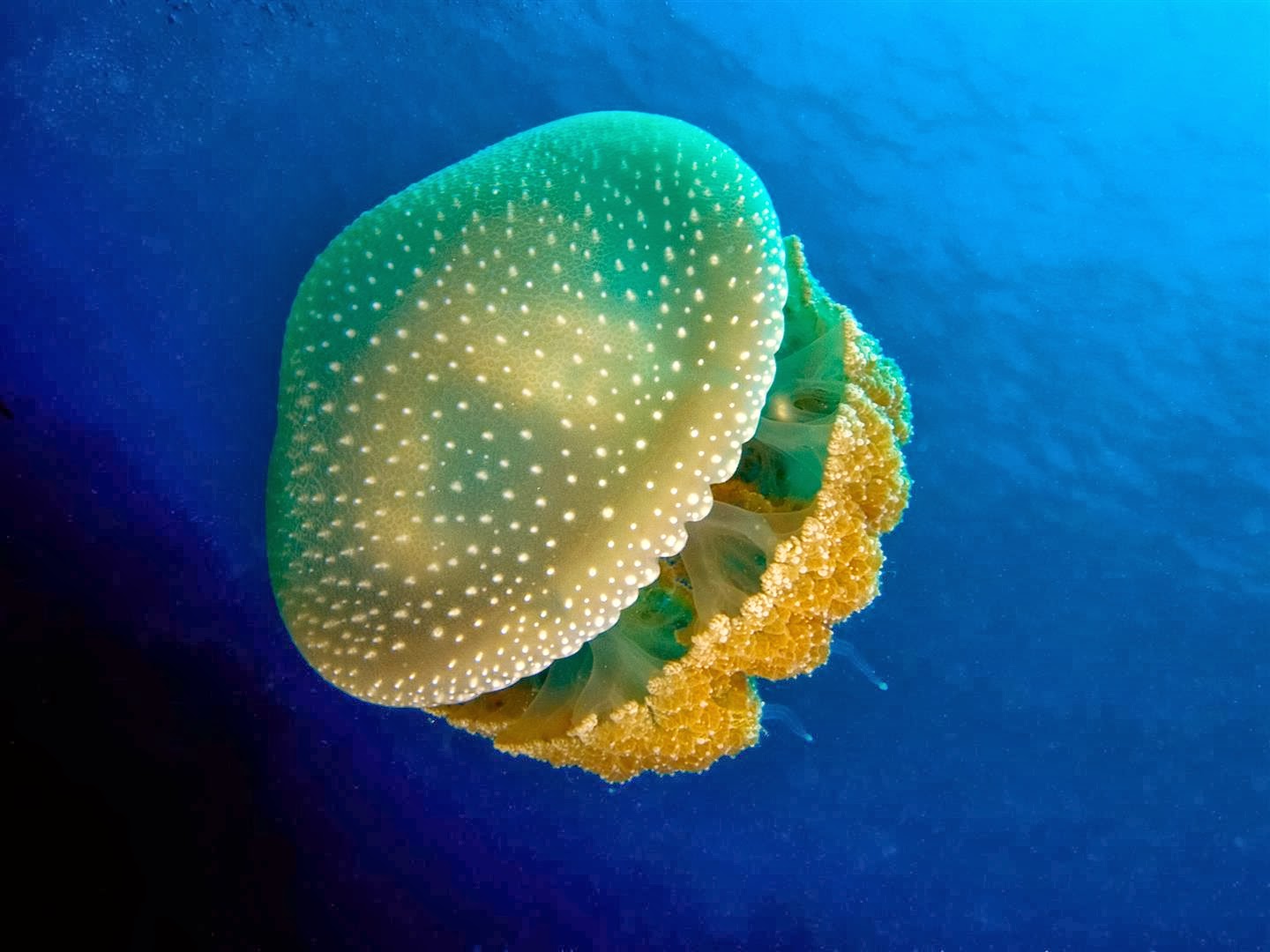
Jellyfish or jellies are the major non-polyp form of individuals of the phylum Cnidaria. They are typified as free-swimming marine animals consisting of a gelatinous umbrella-shaped bell and trailing tentacles. The bell can pulsate for locomotion, while stinging tentacles can be used to capture prey. Jellyfish are found in every ocean, from the surface to the deep sea.


A few jellyfish inhabit freshwater. Large, often colorful, jellyfish are common in coastal zones worldwide. Jellyfish have roamed the seas for at least 500 million years, and possibly 700 million years or more, making them the oldest multi-organ animal. The English popular name jellyfish has been in use since 1796. It has traditionally also been applied to other animals sharing a superficial resemblance.


As jellyfish are not vertebrates, let alone true fish, the word jellyfish is considered by some to be a misnomer. Public aquariums may use the terms jellies or sea jellies instead. Indeed, it may be said that the term "jellies" has become more popular than "jellyfish". In scientific literature, "jelly" and "jellyfish" are often used interchangeably.


A group of jellyfish is sometimes called a bloom or a swarm. "Bloom" is usually used for a large group of jellyfish that gather in a small area, but may also have a time component, referring to seasonal increases, or numbers beyond what was expected. Another collective name for a group of jellyfish is a smack, although this term is not commonly used by scientists who study jellyfish.


Jellyfish are "bloomy" by nature of their life cycles, being produced by their benthic polyps usually in the spring when sunshine and plankton increase, so they appear rather suddenly and often in large numbers, even when an ecosystem is in balance. Using "swarm" usually implies some kind of active ability to stay together, which a few species such as Aurelia, the moon jelly, demonstrate.

Saturday, 21 December 2013

Tigerfish

Tigerfish can refer to fish from various families, and derives from official and colloquial associations of these with the Asian tiger (Panthera tigris). However, the primary species designated by the name "tigerfish" are African and belong to the family Alestidae. Several species belonging to the genus Hydrocynus of the family Alestidae are referred to as "tigerfish," and are particularly prized as gamefish.

Photo Credit

These African fish are found in many rivers and lakes on the continent and are fierce predators with distinctive, proportionally large teeth. The goliath tigerfish (Hydrocynus goliath) is among the most famous tigerfish. It can reportedly reach an adult weight of 50 kg (110 lb), and is found in the Congo River system and Lake Tanganyika. It is the largest member of the Alestidae family.

Photo Credit

Another famous species, simply called the tigerfish (Hydrocynus vittatus), is commonly found in the southernly Okavango Delta, and the Zambezi River, and also in the two biggest lakes along the Zambezi, Lake Kariba in Zambia, Zimbabwe, and Cabora Bassa in Mozambique, and finally in the Jozini dam in South Africa.

Photo Credit

Both the goliath tigerfish and its smaller relative bear a striking resemblance, in appearance and habits, to the dorados of South America. The African alestidae tigerfish species are silver, as opposed to the most famous species of dorado, which is golden. Coincidentally, the dorado is known as the "tigre del rio" (tiger of the river) in its homeland.(Although 'tigre' can refer to any predatory cat in this part of the world)

Photo Credit

In the western gamefishing world, Hydrocynus vittatus is regarded to be Africa's equivalent of the South American piranha,[citation needed] though it belongs to a completely different zoological family. Like the piranha, individual tigerfish have interlocking, razor-sharp teeth, along with streamlined, muscular bodies, and are widely known to be extremely aggressive and capable predators who often hunt in groups.

Friday, 13 December 2013

Spotted eagle ray

The spotted eagle ray (Aetobatus narinari) is a cartilaginous fish of the eagle ray family, Myliobatidae. It can be found globally in tropical regions, including the Gulf of Mexico, Hawaii, off the coast of West Africa, the Indian Ocean, Oceania, and on both coasts of the Americas at depths down to about 80 meters (262 ft). The rays are most commonly seen alone, but occasionally swim in groups. Rays are ovoviviparous, the female retaining the eggs then releasing the young as miniature versions of the parent.

Photo Credit

This ray can be identified by its dark dorsal surface covered in white spots or rings. Near the base of the ray's relatively long tail, just behind the pelvic fins, are several venomous, barbed stingers. Spotted eagle rays commonly feed on small fish and crustaceans, and will sometimes dig with their snouts to look for food buried in the sand of the sea bed. These rays are commonly observed leaping out of the water, and on at least two occasions have been reported as having jumped into boats, in one incident resulting in the death of a woman in the Florida Keys.

Photo Credit

The spotted eagle ray is hunted by a wide variety of sharks. The rays are considered Near Threatened on the IUCN Red List. They are fished mainly in Southeast Asia and Africa, the most common market being in commercial trade and aquariums. They are protected in the Great Barrier Reef. The spotted eagle ray was first described by Swedish botanist Bengt Anders Euphrasén as Raja narinari in 1790 from a specimen collected at an unknown location (possibly the coast of Brazil) during a trip he made to the Antilles, and was later classified as Stoasodon narinari.

Photo Credit

Its current genus name is Ateobatus, derived from the Greek words aetos (eagle) and batis (ray). The spotted eagle ray belongs to the Myliobatidae family, which includes the well known Manta ray. Most rays in the Myliobatidae swim in the open ocean rather than close to the sea floor. The spotted eagle ray has many different common names, including white-spotted eagle ray, bonnet skate, bonnet ray, duckbill ray and spotted duck-billed ray.

Photo Credit

The spotted eagle ray develops ovoviviparously; the eggs are retained in the female and hatch internally, feeding off a yolk sac until live birth. After a gestation period of one year the mother ray will give birth to a maximum of four pups. When the pups are first born, their discs measure from 170-350 millimeters (6.7-14 in) across. The rays mature in 4 to 6 years.

Tuesday, 12 November 2013

Fish

A fish is any member of a paraphyletic group of organisms that consist of all gill-bearing aquatic craniate animals that lack limbs with digits. Included in this definition are the living hagfish, lampreys, and cartilaginous and bony fish, as well as various extinct related groups. Most fish are ectothermic ("cold-blooded"), allowing their body temperatures to vary as ambient temperatures change, though some of the large active swimmers like white shark and tuna can hold a higher core temperature.


Fish are abundant in most bodies of water. They can be found in nearly all aquatic environments, from high mountain streams (e.g., char and gudgeon) to the abyssal and even hadal depths of the deepest oceans (e.g., gulpers and anglerfish). At 32,000 species, fish exhibit greater species diversity than any other group of vertebrates.


Fish are an important resource for humans worldwide, especially as food. Commercial and subsistence fishers hunt fish in wild fisheries (see fishing) or farm them in ponds or in cages in the ocean (see aquaculture). They are also caught by recreational fishers, kept as pets, raised by fishkeepers, and exhibited in public aquaria. Fish have had a role in culture through the ages, serving as deities, religious symbols, and as the subjects of art, books and movies.


Fish do not represent a monophyletic group, and therefore the "evolution of fish" is not studied as a single event. Early fish from the fossil record are represented by a group of small, jawless, armored fish known as Ostracoderms. Jawless fish lineages are mostly extinct. An extant clade, the Lampreys may approximate ancient pre-jawed fish. The first jaws are found in Placodermi fossils.
 

Fish are a paraphyletic group: that is, any clade containing all fish also contains the tetrapods, which are not fish. For this reason, groups such as the "Class Pisces" seen in older reference works are no longer used in formal classifications. Traditional classification divide fish into three extant classes, and with extinct forms sometimes classified within the tree, sometimes as their own classes.

Sunday, 21 July 2013

Goblin shark

The goblin shark (Mitsukurina owstoni) is a rare, poorly known species of deep-sea shark. Sometimes called a "living fossil", it is the only extant representative of the family Mitsukurinidae, a lineage some 125 million years old. This species looks unlike any other shark, with a long flattened snout, highly protrusible jaws containing prominent nail-like teeth, and pink coloration.


It is usually between three and four meters (10-13 ft) long when mature, though can grow considerably larger. Goblin sharks inhabit upper continental slopes, submarine canyons, and seamounts around the world at depths greater than 100 m (330 ft), with adults found deeper than juveniles. Various anatomical features of the goblin shark, such as its flabby body and small fins, suggest that it is sluggish in nature.


This species hunts for teleost fishes, cephalopods, and crustaceans both near the sea floor and in the middle of the water column. Its long snout is covered with ampullae of Lorenzini that enable it to sense minute electric fields produced by nearby prey, which it can snatch up by rapidly extending its jaws. Small numbers of goblin sharks are unintentionally caught by deepwater fisheries.


The International Union for Conservation of Nature (IUCN) has assessed it as Least Concern, citing its wide distribution and low incidence of capture. Differing jaw positions in preserved goblin sharks led to several specimens being erroneously described as distinct species. American ichthyologist David Starr Jordan described the goblin shark in an 1898 issue of Proceedings of the California Academy of Sciences, recognizing the peculiar fish not only as a new species but also a new genus and family.


He based his account on an immature male 107 cm (42 in) long caught in Sagami Bay near Yokohama, Japan. The specimen had been acquired by shipmaster and naturalist Alan Owston, who had given it to Professor Kachiki Mitsukuri at the University of Tokyo, who in turn had brought it to Jordan. Thus, Jordan named the shark Mitsukurina owstoni in honor of these two men. The common name "goblin shark" is a translation of its old Japanese name tenguzame, a tengu being a Japanese mythical creature often depicted with a long nose and red face. Another name for this species is "elfin shark".

Saturday, 20 July 2013

Great White shark

The great white shark, Carcharodon carcharias, also known as the great white, white pointer, white shark, or white death, is a species of large lamniform shark which can be found in the coastal surface waters of all the major oceans. The great white shark is mainly known for its size, with the largest individuals known to have approached or exceeded 6.1 m (20 ft) in length, and 2,268 kg (5,000 lb) in weight.


This shark reaches its maturity around 15 years of age and can have a life span of over 30 years. The great white shark is arguably the world's largest known extant macropredatory fish, and is one of the primary predators of marine mammals. It is also known to prey upon a variety of other marine animals, including fish and seabirds. It is the only known surviving species of its genus Carcharodon, and is ranked first in having the most attacks on humans.


The IUCN list the great white shark as a vulnerable species, while it is included in Appendix II of CITES. The bestselling novel Jaws by Peter Benchley and the subsequent blockbuster film by Steven Spielberg depicted the great white shark as a "ferocious man eater". In reality, humans are not the preferred prey of the great white shark.


In 1758, Carolus Linnaeus gave the great white shark its first scientific name, Squalus carcharias. Later, Sir Andrew Smith gave it Carcharodon as its generic name in 1833, and also in 1873. The generic name was identified with Linnaeus' specific name and the current scientific name Carcharodon carcharias, was finalised. Carcharodon comes from the Greek words karcharos, which means sharp or jagged, and odous, which means tooth.


The great white shark came into existence during the mid-Miocene epoch. The earliest known fossils of the great white shark are about 16 million years old. However, the phylogeny of the great white is still in dispute. The original hypothesis for the great white's origins is that it shares a common ancestor with a prehistoric shark, such as the C. megalodon. Similarities among the physical remains and the extreme size of both the great white and C.

Contact Form

Name

Email *

Message *