Monday, 29 September 2014

Camel the most amazing animal in the world

Speed of Camel is amazing!

Camels can run at up to 65 km/h (40 mph) in short bursts and sustain speeds of up to 40 km/h (25 mph). Bactrian camels weigh 300 to 1,000 kg (660 to 2,200 lb) and dromedaries 300 to 600 kg (660 to 1,320 lb). The male dromedary camel has in its throat an organ called a dulla, a large, inflatable sac he extrudes from his mouth when in rut to assert dominance and attract females.

Bactrian Camel photo source

It resembles a long, swollen, pink tongue hanging out of the side of its mouth. Camels mate by having both male and female sitting on the ground, with the male mounting from behind. The male usually ejaculates three or four times within a single mating session. Camelids are the only ungulates to mate in a sitting position.


Species of Camels

Two surviving species of this animal are the dromedary, or one-humped camel (C. dromedarius), which inhabits the Middle East and the Horn of Africa; and the bactrian, or two-humped camel (C. bactrianus), which inhabits Central Asia. Both species have been domesticated; they provide milk, meat, hair for textiles or goods such as felted pouches, and are working animals with tasks ranging from human transport to bearing loads.


Milk of camels as Staple food!

Camel milk is a staple food of desert nomad tribes and is sometimes considered a meal in and of itself; a nomad can live on only milk for almost a month. Its milk is rich in vitamins, minerals, proteins, and immunoglobulins; compared to cow's milk, it is lower in fat and lactose, and higher in potassium, iron, and vitamin C. Bedouins believe the curative powers of camel milk are enhanced if the camel's diet consists of certain desert plants. Milk can readily be made into a drinkable yogurt, as well as butter or cheese, though the yields for cheese tend to be low.


The New World and Old World camelids diverged 11 million years ago. In spite of this, these species can still hybridize and produce fertile offspring. The hybrid camel has one hump, though it has an indentation 4 to 12 cm (1.6 - 4.7 in) deep that divides the front from the back. The hybrid is 2.15 m (7 ft 1 in) at the shoulder and 2.32 m (7 ft 7 in) tall at the hump. It weighs an average of 650 kg (1,430 lb) and can carry around 400 to 450 kg (880 to 990 lb), which is more than either the dromedary or Bactrian can. Article source

Thursday, 8 May 2014

Grizzly Bear Wildlife Animal


Life of Grizzly bear

The grizzly bear and brown bears are the one species of two different continents. Grizzly is sometimes also called as silvertip bear. Grizzlies are normally solitary and active animals. In coastal regions these are living gather around streams, rivers, lakes and ponds. Female produce 1-4 young cubs every year.

How do Grizzly bear look like?

Most adult female grizzlies weigh 130 t0 200 kg. while adult males weigh on average 180 to 360 kg. The average total length in this subspecies is 198 cm (6.50 ft), with an average shoulder height of 102 cm (3.35 ft) and hindfoot length of 28 cm (11 in). Newborn bears may weigh less than 500 grams.


A large coastal male of this size may stand up to 3 metres (9.8 ft) tall on its hind legs and be up to 1.5 metres (4.9 ft) at the shoulder. Although variable from blond to nearly black grizzly bear fur is typically brown in color with white tips.

Reproduction of Grizzly bear

Grizzly bear have one of the lowest reproductive rates of all terrestrial mammals in North America. This is due to numerous ecological factors. These bears do not reach sexual maturity until they are at least five years old. Once mated with a male in the summer, the female delays embryo implantation until hibernation, during which miscarriage can occur if the female does not receive the proper nutrients and caloric intake. On average, females produce two cubs in a litter and the mother cares for the cubs for up to two years, during which the mother grizzly bear will not mate.

Wednesday, 7 May 2014

Lion A Big Cat Facts

Biography of Lions

The scientific name of  lion is Panthera leo. The late Pleistocene about 10,000 years ago, the lion was the most widespread large land mammal after humans. They were found in most of Africa, across Eurasia from western Europe to India, and in the Americas from the Yukon to Peru. The lion is a vulnerable species, having seen a major population decline in its African range of 30 to 50% per two decades during the second half of the 20th century.

Population of Lions

Lion populations are untenable outside designated reserves and national parks. Although the cause of the decline is not fully understood, habitat loss and conflicts with humans are currently the greatest causes of concern. Within Africa, the West African lion population is particularly endangered.

How man years Lions can live?

Lions live for 10 to 14 years in the wild while in captivity they can live longer than 20 years. In the wild, males seldom live longer than 10 years, as injuries sustained from continual fighting with rival males greatly reduce their longevity. They typically inhabit savanna and grassland, although they may take to bush and forest.

Behavior of Lions

Lions are unusually social compared to other cats. A pride of lions consists of related females and offspring and a small number of adult males. Groups of female lions typically hunt together, preying mostly on large ungulates. Lions are apex and keystone predators, although they scavenge as opportunity allows. While lions do not typically hunt humans, some have been known to do so. Sleeping mainly during the day, lions are primarily nocturnal, although bordering on crepuscular in nature.

Article source

Saturday, 3 May 2014

Australian Kangaroos Facts

Facts about Australian Kangaroos

The Kangaroo is an unofficial symbol of Australia. It  is used by some of Australia's well known organisations, including Qantas and the Royal Australian Air Force. The kangaroo is important to both Australian culture and the national image, and consequently there are numerous popular culture references.

Australian wild Kangaroo

Wild kangaroos are shot for meat, leather hides, and to protect grazing land. Although controversial, harvesting kangaroo meat has some environmental advantages to limit over-grazing and the meat has perceived health benefits for human consumption compared with traditional meats due to the low level of fat on kangaroos.

Social behavior of Kangaroos

Groups of kangaroos are called mobs. Mobs usually have 10 or more kangaroos in them. Living in mobs provides protection for some of the weaker members of the group. The size and stability of the mobs vary between geographic regions, with eastern Australia having larger and more stable aggregations than in arid areas farther west. Larger aggregations display high amounts of interactions and complex social structures, comparable to that of ungulates. One common behaviour is nose touching and sniffing, which mostly occurs when an individual joins a group. The kangaroos performing the sniffing gain much information from smell cues.
  • Kangaroos Adaptations

Kangaroos have developed a number of adaptations to a dry infertile country and highly variable climate. As with all marsupials, the young are born at a very early stage of development after a gestation of 31 to 36 days. At this stage only the forelimbs are somewhat developed, to allow the newborn to climb to the pouch and attach to a teat. In comparison, a human embryo at a similar stage of development would be about seven weeks old, and premature babies born at less than 23 weeks are usually not mature enough to survive.

Wednesday, 23 April 2014

Gopher

Biography of Gopher

They are commonly known for their extensive tunneling activities. Gophers are endemic to North and Central America. The name "pocket gopher" on its own may be used to refer to any of a number of genera within the family. These are the "true" gophers; however there are several ground squirrels of the family Sciuridae that are often mistakenly called gophers as well.


Description of Gopher

Gophers weigh around 230 g and are about 6 to 8 inches long in body length, with a tail 1 to 2 inches long. A few species reach weights approaching 1 kg. Within any species, the males are larger than the females and can be nearly double their weight. Their lifespan is normally one to three years assuming no diseases or predation. The maximum life span for the pocket gopher is approximately five years. Some of them, such as those in the genus geomys, have lifespans that have been documented as up to seven years in the wild.
  • Behavior of Gopher
All pocket gophers create a network of tunnel systems that provide protection and a means of collecting food. They are larder hoarders, and their cheek pouches are used for transporting food back to their burrows. They can collect large hoards. Unlike its close relative the ground squirrel, gopher do not live in large communities or show themselves above ground. The entrances can be identified by small piles of loose dirt covering the opening.

For more detail Wikipedia

Wednesday, 16 April 2014

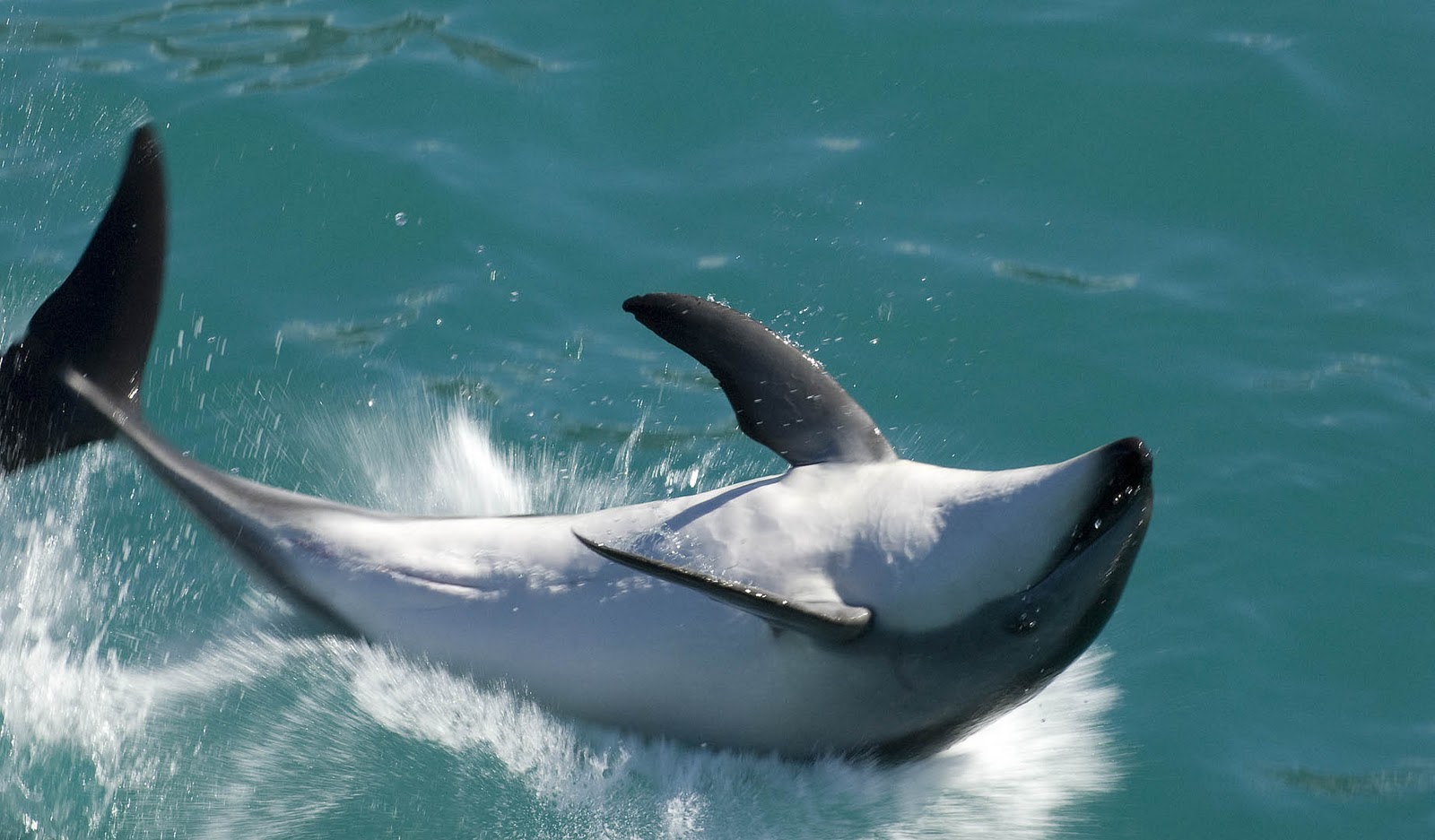
Dusky Dolphins

The dolphin is unclear small to medium length in relation to other species of the family. The dark dolphins off the coast of Peru, where they are up to 210 cm (6 feet) in length and 100 kg of thrust (210 pounds) weight. The dolphin back is dark gray or black, and the dorsal fin is clearly bicolor corresponding margin of the back in color, but the rear edge is much lighter gray white. Dolphins have long dark gray spot on the front, a short beak and dark things.


The dolphin has a dark semi-discontinuous circumpolar region. Dolphins can be found off the coast of South America, southwestern Africa, South Australia and Tasmania, New Zealand and some oceanic islands. From South America, dark dolphins beach in the south of Peru to Cape Horn in the western and southern Patagonia at about 36 ° S in the east. Dolphins are dark in New Zealand waters. In Africa, the dark areas of dolphins in the Bay of Lobito, Angola, north of False Bay, South Africa in the south.


Dolphins prefer dark and cold water upwelling of cold streams. Dark Dolphins over large distances (780 km), but are not well defined seasonal migrations. In Argentina, dark dolphins closely associated with Southern Right whales and sea lions from South America. They were found about dolphins, but apparently not communicate with them and feed Risso's dolphin. In New Zealand, to mix dark dolphins common dolphins. Dark dolphins were also observed with the dolphins in the Southern Right Whales and pilot whales from southwestern Africa. Dark dolphins live in fission-fusion of the Company with the size of most groups will decline during foraging and the size of the groups. During rest and travel in the Golfo San José from Peninsula Valdes, dolphins regularly alternating small and large groups, groups and socio-sexual encounter a variety of partners.


Studies of dolphins of Kaikoura, New Zealand, normally dolphins live in large groups, which are divided into smaller subgroups. These subgroups of adults coupling (contact groups) composed mothers with small groups (kindergarten) and non-breeding adults. Dark Dolphins a promiscuous mating in which men and women who mate with multiple partners. In contact groups males behind the females at high speed to pursue. Unlike the male dolphins dolphins dark males can monopolize females. The time can be as women dark dolphins first reproduce vary by region. New Zealand first reproduce the dolphins at about 7-8 years 6-7 years possibly with dolphins in Argentina. 
 

As with all types of couples where women with multiple partners, men have testicles and dark Dolphins Dolphins sperm competitionDusky sometimes engage in sexual behavior for reasons other than reproduction, perhaps duties greeting or to increase social communication. Homosexual behavior between males was observed. Dolphins have sex for social reasons tend to be more relaxed. Females with young often in groups in shallow water nurseries to collect. The formation of groups of kindergarten shallow waters also allow the members, prey that hunt live in these waters.

Gharial

Like all large crocodiles, gharials life begins quite low. Young gharials, a length of 1 m (3.3 feet) in 18 months. The average body weight of the species 159-250 kg (350-550 lb). Gharials exceeded in length only by the saltwater crocodile. Gharials tail "well developed laterally flattened and webbed rear feet provide tremendous maneuverability in their deepwater habitats. On land, however, an adult gharial only to push forward and slide on the belly.
 
 
Continued improvement of swimming ability, body shape gavial relatively cylindrical, compared to the larger, more well-built body of water or a Nile crocodile salt for the detection of different prey consists edges of streams. The gharial's long narrow snout is proportionally shorter and thicker as an animal ages. Growth bulb at the end of the mouth of a crocodile man gharials accessible as sexual dimorphism.

The Nepali word Ghara घड़ा means earthenware pot, water, vase, pitcher. cheeks are nested, sharp teeth lined 27 to 29 above and 25 or 26 lower teeth on each side. Opening is a nasal gharial is smaller than the above-temporal pit. the front lower edge of the track (Jugal) is raised and lower jaws is extremely long, arranged in 23 or 24 teeth. nuchal and dorsal scales form a shield 21 or 22 continuous transverse series. gavials an outer row of scales soft, smooth or slightly beside keeled dorsal bone platesTypically, adult gharials dark olive color, while boys are pale olive, with dark brown spots or cross bands.
 

Gharials once in all the major rivers of the Indian subcontinent, spread over prospered rivers in the northern part of the Indus in Pakistan through the Gangetic plains of the Irrawaddy in Myanmar. Today, they disappeared in the river Indus, the Brahmaputra of Bhutan and Bangladesh and in the Irrawaddy River. Their distribution is limited to only 2% of their former range India are small populations exist and takes into rivers Chambal National Sanctuary, Katarniaghat Wildlife Sanctuary, Son River Sanctuary and the rainforest biome of Mahanadi in Satkosia Gorge Sanctuary, Orissa, where they apparently can not reproduce.
 

In Nepal, small populations are present and slowly recovering in tributaries of the Ganges, the river Rapti-Narayani system in Chitwan National Park and the Karnali-Babai river system in Bardia National Park. The saltwater crocodile (Crocodylus porosus) in the Irrawaddy Delta In 1977, four nests in the river Girwa Katarniaghat Wildlife Sanctuary, where 909 gharials were published until 2006. In 1978, twelve nests in the Chambal river in National Chambal Sanctuary, where 3776 and 2006 were released gharials included. Newborns are particularly vulnerable to downstream protected areas emptied during the annual monsoon flooding Unlike most crocodiles.

Tuesday, 15 April 2014

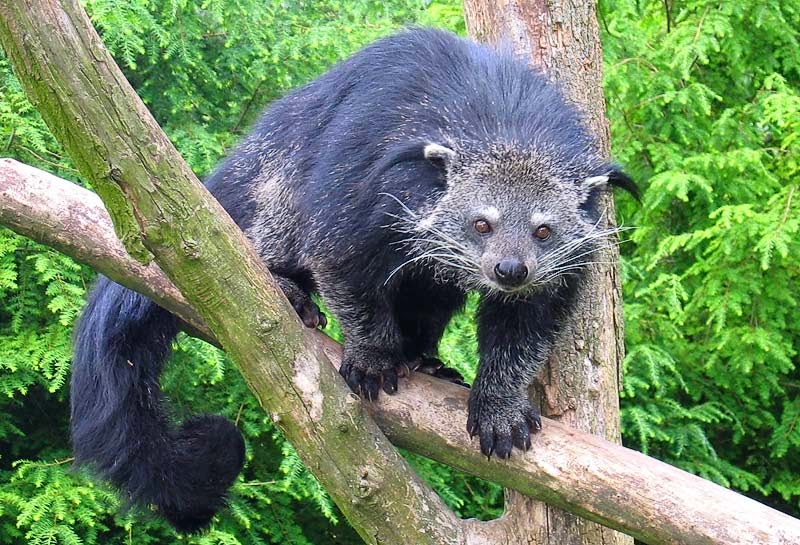
Binturong

The binturong is sometimes compared to a bear, but it is much smaller than the size of a small dog. However, it is the largest living species of the family Viverridae equal the African civet. His head and average body length is usually between 60-97 cm (24-38 inches) and weight is usually 9-20 kg (20-44 lb), although it is known extraordinary people, 23 kg (51 weigh £) or more. His body is covered with thick black hair and thick. The hair is often silvery white on the top, giving the animal a little grizzled general. 


Bearcats ears are small and round, and small eyes. Females are 20% larger than males. Its natural habitat is the dense rainforest canopy primary or secondary. It is also found naturally in dry forests grassland mosaics. Period of heat binturong is 81 days, with a gestation period of 91 days. The binturong is one of about 100 species of mammals considered by many experts to be able to farm diapause or delayed implantation, which allows the female species over time of birth with favorable environmental conditions.


The Bearcats are solitary and nocturnal. It climbs trees and leaps from branch to branch, clinging to its tail and claws, while searching for food. No studies on food preferences were made in nature. However, the main source of food for wild fruits binturongs probably. Other foods known to eat eggs, shoots, leaves, arthropods and small vertebrates such as rodents or birds have been cases where banks were binturongs rivers and fish caught said.


Bearcats uses its tail to communicate through scent glands located on either side of the anus in men and women. Scent glands of women and couples on either side of the vulva. Binturong musk is often compared to popcorn and hot buttered cornbread. Bearcats brush his tail against trees and howls to announce its presence to other binturongs. Although sympatric with several potential predators, including leopards, clouded leopards and reticulated pythons, predation of adults reported rarely.


The binturong is believed that one of the feistiest animals are in the wild. Although the Bearcats always occurs in a wide range of populations of these species has been greatly reduced. The IUCN now lists species endangered. The main threat to the species is the destruction of the forest habitat. While South Asia has plans, rampant deforestation. The other major threat to the species is the direct collection of samples (often illegally) for wildlife trade and hunting.

Opossum

Opossums make up the largest order of marsupials in the Western Hemisphere, including 103 or more species in 19 genera. They are also commonly called possums, though that term technically refers to Australian fauna of the suborder Phalangeriformes. The Virginia opossum was the first animal to be named an opossum; usage of the name was published in 1610.
 
Didelphimorphs are marsupials small and medium enterprises, with the greatest excess of the size of a large house cat and the smallest the size of a small mouse. The incisors are very small, large canines and molars of the tricuspid valve. Didelphimorphs plantigrade stance (feet flat on the floor) and hind legs have clawless opposable digit. As some New World monkeys have prehensile tails possums. Like all marsupials, the awn hair hair only, and the females have a pouch. The tail and legs are scales. In particular, the twins opossum is a penis-shaped gland named fork generic (Greek for "brothers") Didelphis

  
Opossums have an incredibly strong immune system, and show partial or total immunity to the venom of rattlesnakes and other snakes moccasin. Opossums are about eight times less likely to carry rabies than wild dogs and about 800 opossums are infected with this virus As a marsupial, the opossum has a reproductive system including a divided uterus and marsupium, the bag is. Opossums no placenta, but short design, simple and unlike placental mammals is not fully functional. The species are moderately sexually dimorphic, with males usually slightly larger, heavier and larger dogs than females.
 

The biggest difference between mammals and marsupial possum penis male and female branches fork vaginal (the origin of the Latin word "Didelphis", ie two wombed). Opossum sperm sperm has a conjugate form matching pairs in the epididymis. Bound pairs dissociate into separate sperm before fertilization. Female opossums often give birth to a large number of young people, most of which are not tied to a teat, although as many thirteen young can attach, and therefore survive, depending on species. As nocturnal animals, they favor dark, secure areas. When "Playing Possum" animal's lips back, teeth bared.
 
 
Saliva foams around the mouth, eyes closed or semi-closed, and the smelly liquid His anal glands rigidly curly can be pushed, again without even animals usually reactionThe again. Threatened opossums (especially males) growling deeply, raising their pitch as the threat becomes more urgent. When separated or distressed, baby opossums will make a sneezing noise to signal their mother. When threatened, the baby opens his mouth and breathe quietly until the threat is gone. Or whining noise is a defensive process that helps the opossum deter other animals approaching.

Sunday, 13 April 2014

Arctic Fox

Arctic Fox lives in some of the extreme cold of the planet. Arctic Fox has so his good ear is able to locate the position of prey under the snow. Arctic Fox tends to be active from early September to early May. Foxes tend to form monogamous pairs in the breeding season. Young child from the previous year may remain with their parents to help rear younger siblings. Arctic fox diet, in general, find any small animal it: lemmings, voles, hares, owls, eggs, and carrion, Lemmings, etc., are the most common prey.
 
Arctic fox Credit

A family of foxes can eat dozens of lemmings each day. In April and May the Arctic Fox also fall prey ringed seal pups when the young animals are confined to a snow den and are relatively helpless. If there is an oversupply of food hunted, the Arctic Fox will bury what the family can not eat. When its normal prey is scarce, the arctic fox destroyed the remains and feces even larger predators such as polar bears, though bears prey includes the arctic fox itself.


The tail is 31 cm (12.2 inches) long in men and 30 cm (11.8 inches) in women. It is 25-30 cm (9.8 to 11.8 inches) in height at the shoulder average male weighs 3.5 kg (7.7 lb) with a range from 3.2 to 9.4 kg (7, 1 -21 £), while females average 2.9 kg (6.4 lb) with a range from 1.4 to 3.2 kg (3.1 to 7.1 lb) Arctic Fox one circumpolar range of what means that it found in the Arctic, including the outer edges of Greenland, Russia, Canada, Alaska and Svalbard and subarctic and alpine as Iceland and mainland alpine Scandinavia. Estimate of the total population in Norway, Sweden and Finland, the only 120 adults.


Arctic fox is the only native land mammal to IcelandArctic Fox Súðavík center contains an exhibition on the Arctic fox and conducts studies on the impact of tourism on the population Arctic fox species richness tends to loop with the population of lemmings and voles (cycle 3-to-4-years) fluctuate. Populations are particularly vulnerable to over the years when prey population crashes and uncontrolled fall uprooted nearly two subpopulations.
 

The Arctic fox fur, blue schist were expressed recessive genes invaluable. Were various previously fox-free Aleutian promoted in 1920. Arctic Fox Red Fox is losing ground to the sea. Red foxes dominate, kill to start where their ranges overlap arctic foxes and their kit. An alternative explanation involves gains red fox gray wolf: Historically, it has maintained the number of red foxes down, but the wolf was hunted almost to extinction in much of its former range, the Red Fox population grew larger, and in the predator niche northern Europe, there are programs in place that allow the hunting of Red Fox in the Arctic fox.

Saturday, 12 April 2014

Aardvark

The aardvark is a medium-sized, burrowing, nocturnal mammal native to Africa. It is the only living species of the order Tubulidentata, although other prehistoric species and genera of Tubulidentata are known. It is sometimes colloquially called "African antbear", "anteater", or the "Cape anteater" after the Cape of Good Hope. The name comes from earlier Afrikaans (erdvark) and means "earth pig" or "ground pig" (aarde earth/ground, vark pig), because of its burrowing habits (similar origin to the name groundhog).


The name Orycteropus means burrowing foot, and the name afer refers to Africa. The name of the aardvarks's order, Tubulidentata comes from the tubule style teeth. The aardvark is vaguely pig-like in appearance. Its body is stout with a prominently arched back and is sparsely covered with coarse hairs. The limbs are of moderate length, with the rear legs being longer than the forelegs. The front feet have lost the pollex (or 'thumb'), resulting in four toes, while the rear feet have all five toes.


Each toe bears a large, robust nail which is somewhat flattened and shovel-like, and appears to be intermediate between a claw and a hoof. Whereas the aardvark is considered digitigrade, it appears at time to be plantigrade. This confusion happens because when it squats it stands on its soles. The aardvark's stomach has a muscular pyloric area that acts as a gizzard, (it grinds the food up) to make chewing not important. Its cecum is large.


Both males and females emit a strong smelling secretion from an anal gland. Its salivary glands are highly developed and almost completely ring the neck, and their output is what causes the tongue to maintain its tackiness. The female has two pairs of teats in the inguinal region. Aardvarks live in sub-Saharan Africa, where there is suitable habitat for them to live, such as savannas, grasslands, woodlands and bushland, and available food (i.e., ants and termites).


They hide in dark underground burrows to avoid the warm weather. The only major habitat that they are not present in is swamp forest, as the high water table interferes with digging. They have been documented as high as 3,200 metres (10,500 ft) in Ethiopia. They are known to live throughout sub-Saharan Africa all the way to South Africa with few exceptions. These exceptions are coastal areas of Namibia, Ivory Coast, and Ghana. They are also not present in Madagascar. They avoid rocky terrain as it causes problems with digging.

Friday, 11 April 2014

Fennec Fox

It is the smallest canid species worldwide. Ears fennec feature is the largest among all foxes relative to body size, and are used to dissipate heat, as have many of the blood vessels near the skin. Scientists have found that while there are similarities, there are many differences, the Fennec fox apart from other fox species, including physical and social. Vulpes Zerda, which means that the Fennec fox a fox is true and Fennecus zerda to Fennec fox shows one of his own species: It has taken two conflicting classifications.
 
 
Physically, the fennec lacks the musk glands of other fox species, and has only 32 pairs of chromosomes, while other fox species have between 35 and 39. The species also shows the unusual behavior of foxes that live in herds, while other fox species Solo. Fennec fox social behavior information, mainly based on captive animals. Play behavior is common in adults of the species. Fennec Foxes make a variety of sounds, including barking, a sound like a purring cat and a growl when threatened.


The Fennec fox is an omnivore. Food sources are rodents, insects, birds, eggs and rabbits. When hunting, fox-sized ears, as the Fennec fox, or bat ears, may seem to look at the ground while his head from side to side to locate the position of the prey, either underground or hidden in the surface. There are reports that fennec foxes climb palm trees while feeding on fruit, but some experts as unlikely relationship, unless the lower branches are for the support. The species is able to live without free water, as their kidneys may limit water loss. Fennec penetration of the formation of dew.
 
 
Fennec foxes are social animals that mate for life, with each pair or family controlling their own territory. In the wild, mating usually occurs in January and February, cubs are born between March and April. The gestation period is usually between 50-52 days, even if said period of 62 and 63 days of gestation of foxes in captivity. When born with folded ears kit and eyes closed, eyes open in about ten days, and the ears lifting soon. The life of a Fennec fox was recorded up to 14 years in captivity.


The species is found in northern Africa and Asia. A fennec typical cave dug in the sand, either in open spaces or places of plants with stable sand dunes as their ideal habitat is protected. Fennec Fox as "least concern" classified in the IUCN Red List and CITES falling as Appendix II species: species not necessarily threatened with extinction, but in which trade can be controlled in order to avoid utilization incompatible with its survive. Observations on Traders trapping fennec foxes in Northern Africa for exhibition or sale to tourists in southern Morocco, the fennec fox is commonly seen in the sandy areas of permanent settlements.

Saturday, 29 March 2014

Parrotfish

Parrotfishes are a group of about 90 species traditionally regarded as a family (Scaridae), but now often considered a subfamily (Scarinae) of the wrasses. They are found in relatively shallow tropical and subtropical oceans throughout the world, displaying their largest species richness in the Indo-Pacific. They are found in coral reefs, rocky coasts, and seagrass beds, and play a significant role in bioerosion.


Traditionally, the parrotfishes have been considered a family level taxon, Scaridae. Although phylogenetic and evolutionary analysis of parrotfishes is ongoing, they are now accepted to be a clade in the tribe Cheilini, and are now commonly referred to as scarine labrids (subfamily Scarinae, family Labridae). Some authorities have preferred to maintain the parrotfishes as a family-level taxon, resulting in Labridae not being monophyletic (unless split into several families).


Parrotfish are named for their dentition, which also is distinct from that of other labrids. Their numerous teeth are arranged in a tightly packed mosaic on the external surface of their jaw bones, forming a parrot-like beak with which they rasp algae from coral and other rocky substrates. Maximum sizes vary within the family, with the majority of species reaching 30-50 cm (12-20 in) in length. However, a few species reach lengths in excess of 1 m (3 ft 3 in), and the green humphead parrotfish can reach up to 1.3 m (4 ft 3 in).
 
Parrotfish Credit

A number of parrotfish species, including the queen parrotfish (Scarus vetula), secrete a mucus cocoon, particularly at night. Prior to going to sleep, some species extrude mucus from their mouths, forming a protective cocoon that envelops the fish, presumably hiding its scent from potential predators. This mucus envelope may also act as an early warning system, allowing the parrotfish to flee when it detects predators such as moray eels disturbing the membrane.
 

Although they are considered to be herbivores, parrotfish eat a wide variety of reef organisms, and they are not necessarily vegetarian. Species such as the green humphead parrotfish (Bolbometopon muricatum) include coral (polyps) in their diets. Their feeding activity is important for the production and distribution of coral sands in the reef biome, and can prevent algae from choking coral. The teeth grow continuously, replacing material worn away by feeding.

Lionfish

Lionfish are known to devour many aquarium fish. Pterois are unusual in that they are among the few species successfully establish populations in open marine systems. Extreme temperatures are geographically restricted distribution in aquatic species, indicating that tolerance to temperature plays a role in survival of lionfish range, reproduction and distribution. Pterois stretched along the east coast of the United States and employs thermal appropriate areas within ten years.


Lion parasites are rarely seen and rarely thought. Lionfish are known for their poisonous rays, a feature that is common among marine fish in the coral reefs of the east coast. Severe allergic reactions to poison Pterois are typically chest pain, severe shortness of breath, a fall in blood pressure, swelling of the tongue, sweating, runny nose or clear speechThe lion is a predator comes from the Indo-Pacific. The aggressive prey on small fish and invertebrates. Lionfish take a hostile attitude and are territorial towards other reef fish.
 

It is said that this introduction can be caused when Hurricane Andrew in an aquarium in south Florida destroyed, also believed to six lions were accidentally released in Biscayne Bay, Florida after Hurricane Andrew in 1992. The capture of lionfish first document in the Atlantic came in Dania Beach, Florida. In 2001, NOAA documented several sightings of lionfish off the coast of Florida, Georgia, South Carolina, North Carolina, and Bermuda and the Bahamas were discovered in 2004.


Pterois volitans and Pterois miles are from tropical and subtropical regions of southern Japan and South Korea to the east coast of Australia, Indonesia, Micronesia, French Polynesia and the South Pacific lionfish Champions adults found along the east coast States of Cape Hatteras, North Carolina, Florida, Bermuda, the Bahamas and the wider Caribbean, including Turks and Caicos, Haiti, Cuba, Dominican Republic, Cayman Islands, Aruba, Curacao, Bonaire, Puerto Rico, St. Croix, Belize, Honduras and Mexico. Population is growing in invaded areas, resulting population explosion of up to 700% in some areas between 2004 and 2008. 
 
 
Although the timeline of observation points on the east coast of Florida, as the original source of the invasion of the western Atlantic Ocean, the relationship between the U.S. East Coast and invasion of lionfish is uncertain Bahamas The population density of the invasive lionfish rise very rapidly, and we are working in diverse fields to check. A study in 2010 with the population data modeling collected using the known history of life lionfish inhabit coral reefs in the Caribbean to find the best way to eradicate. The study has shown that the most effective way to maintain uniform current density lion population, at least 27% of the adult population should be killed monthly invasive.

Tuesday, 25 March 2014

Jaguar

The jaguar is the largest feline on the American continent, with jaguars also being the third biggest cat in the world behind the African lion and the Asian tiger. Jaguars have the strongest bite force of all the cats and like other pantherines they can roar. The jaguar is indigenous to the Western Hemisphere. Jaguars inhabit the tropical rainforest's of South America with the elusive jaguar spending a great deal of its time asleep in the trees or hunting in dense undergrowth. However, due to the habitat loss within this jaguar kingdom, the jaguar population numbers are declining making jaguars an endangered species.


Jaguars have a similar rosetting pattern to a leopard, but the jaguar has a much heavier and sturdier build. Jaguars hold the reputation for being very aggressive, though attacks on humans have historically been rare. Undoubtedly a strikingly beautiful animal, the jaguar has caught the attention of scientists and hunters alike, with many jaguar individuals having been poached for their distinctively patterned fur. Black jaguars occur from time to time. In jaguars the black colouration is a simple dominant gene. Two black jaguars can produce a lighter spotted cub in a litter of blacks. As with black leopards, you can see the spotting as black on black in strong sunlight.


Jaguars tend to prefer thick, dense, moist jungle where the jaguar has plenty of cover in order to successfully hunt and the ambush prey. Although this is the case, jaguars appear to be fairly adaptable animals and jaguars have been known to reside in reed thickets, shrub land and swamps. A jaguar was found in the desert region of southern Arizona a couple of years ago. The highest concentration of jaguars is today found around the Amazon Basin, where there is plenty of food, water and shelter for the jaguar to live undisturbed.


Although jaguar cubs are generally born between the months of December and March, it is not uncommon for jaguar cubs to be born throughout the year. Female jaguars typically give birth to two or three jaguar cubs. In mating season, the female jaguar will use loud vocal calls to attract a male jaguar into her territory. Once the jaguar cubs are born however, the female jaguar will not tolerate the male jaguar in her territory as the female jaguar becomes very protective of her cubs at this stage. Jaguar cubs are born blind and gain their sight after about two weeks.
 

Jaguar populations are rapidly declining. The animal is considered Near Threatened by the International Union for Conservation of Nature and Natural Resources, meaning it may be threatened with extinction in the near future. The loss of parts of its range, including its virtual elimination from its historic northern areas and the increasing fragmentation of the remaining range, have contributed to this status.

Contact Form

Name

Email *

Message *